
When we talk about fighting climate change, we often hear about "emissions." But what exactly are they, and why do Scope 1, 2, and 3 emissions play such a big role in sustainability strategies?
What Are Emissions?
Emissions are invisible gases released into the air from everyday activities — like driving a car, powering factories, or even farming animals. These gases, including carbon dioxide (CO₂) and methane (CH₄), trap heat in the atmosphere — a process known as the greenhouse effect — and contribute to global warming and climate change.
To fight climate change effectively, we need to understand where these emissions come from. That's where the concept of emission scopes comes in.
The Three Scopes of Emissions
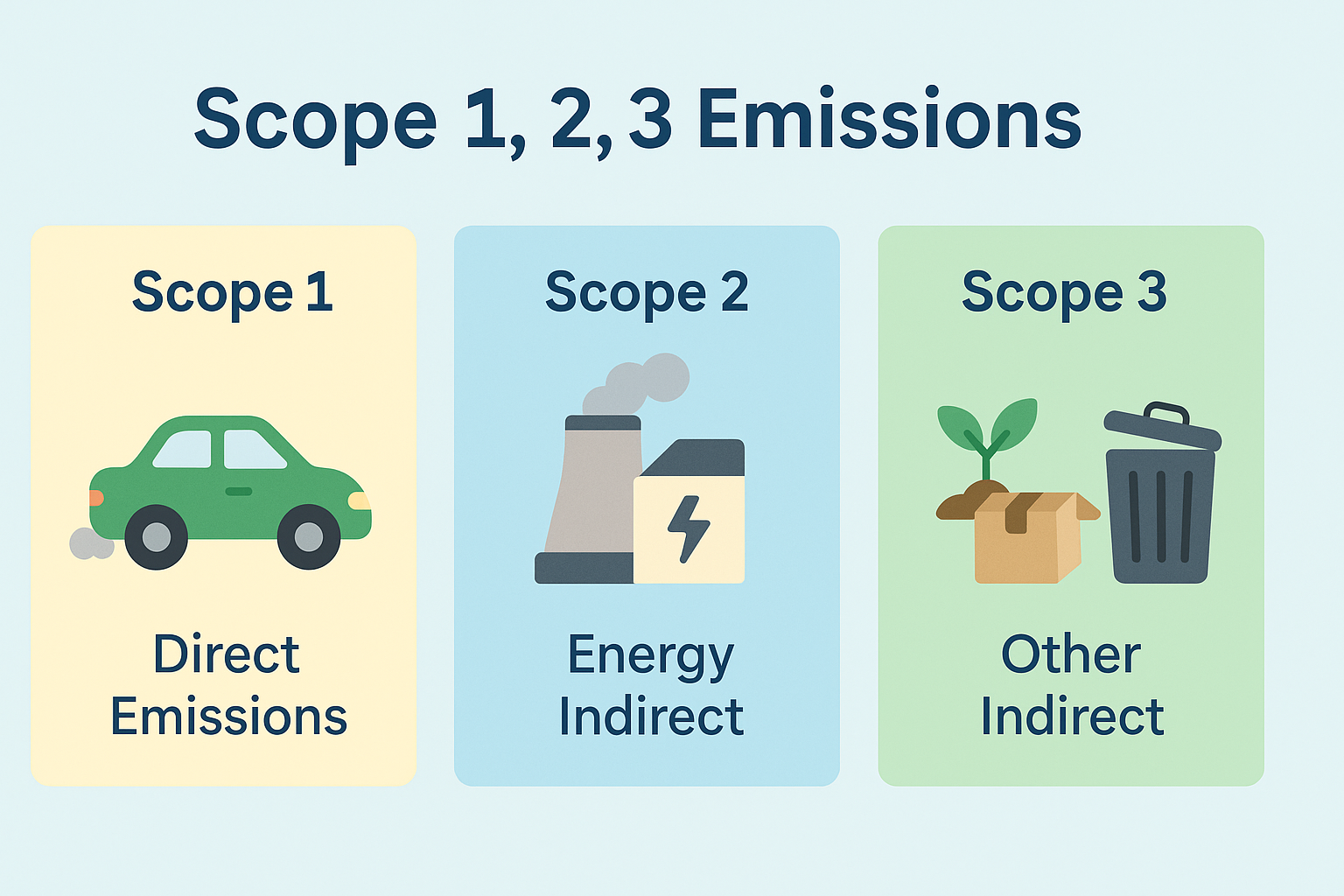
Direct Emissions
These are emissions that come directly from a company's owned or controlled sources — think of fuel burned in company vehicles or gas used to heat buildings.
Because these emissions happen on-site or within the company's direct operations, they are the most straightforward to measure and control.
Indirect Energy Emissions
Scope 2 covers emissions from the electricity, heating, or cooling a company buys. Even though the emissions don't occur on-site, they're still tied to the company's energy use.
Switching to renewable energy sources is one of the most effective ways to reduce Scope 2 emissions.
Other Indirect Emissions
This category includes all other indirect emissions that occur throughout the value chain — both upstream and downstream. Examples include:
- Transporting goods
- Manufacturing materials or growing crops
- Waste disposal
- Employee travel and commuting
- Product use by customers
Why Scope 3 Emissions Matter
Scope 3 emissions are often the largest slice of a company's total carbon footprint. They go far beyond what happens inside the company — they span the entire value chain, from raw material extraction to end-of-life product disposal.
These numbers show why Scope 3 reporting is critical — in most industries, the majority of a company's climate impact lies outside its direct control, embedded in the supply chain and product lifecycle.
The Bottom Line
Accurately measuring and transparently reporting Scope 3 emissions is critical for identifying hotspots in the value chain, setting meaningful reduction targets, and fostering accountability across entire industries.
Organizations that take Scope 3 seriously don't just improve their own footprint — they drive change across their entire ecosystem of suppliers, partners, and customers.
Ready to measure your full carbon footprint?
Get complete visibility across Scope 1, 2, and 3 emissions with Verde 365.